Physical AI
In Physical AI, model selection starts with the task itself
In physical systems a correct answer is not enough; when it turns into action, and on which hardware, matters too. We take a field view of model selection, token economics and VLM/VLA architectures.
 Alp Eren ÖzalpVice President of R&D & Software Development
A robot may correctly locate a moving part and still be too late by the time it moves to grasp it. Whether an answer we would call correct on screen actually works in the physical world also depends on when, and on which hardware, it turns into action. That is why, in Physical AI, we begin model selection by defining the capabilities the task requires. Leaving every decision to the largest model does not mean we will get our money's worth from the tokens spent and the hardware used over the course of a task.
At Cerebrum Tech, in auto damage assessment scenarios for our clients in the insurance sector, we fine-tuned the Qwen/Qwen3.8-27B model and matched Claude Opus 5.5 with 95% accuracy, while speeding up action times by 50% and cutting token costs by 80%. This experience showed how decisive adapting a model to the task can be in model selection. We approach our ongoing Physical AI R&D with the same perspective. For different jobs such as perception and motion planning, we evaluate the required accuracy, latency and hardware needs together. We also treat token economics as a way to compare costs against the system we would be replacing.
From token price to task cost
It is easy to talk about token economics in terms of unit price. Yet a cheap response does not mean the job was done cheaply. Retries, human review and the time spent correcting faulty output can change the total cost per correct decision. If a smaller model needs several attempts to finish what a stronger model completes in one, the advantage on the price sheet can disappear.
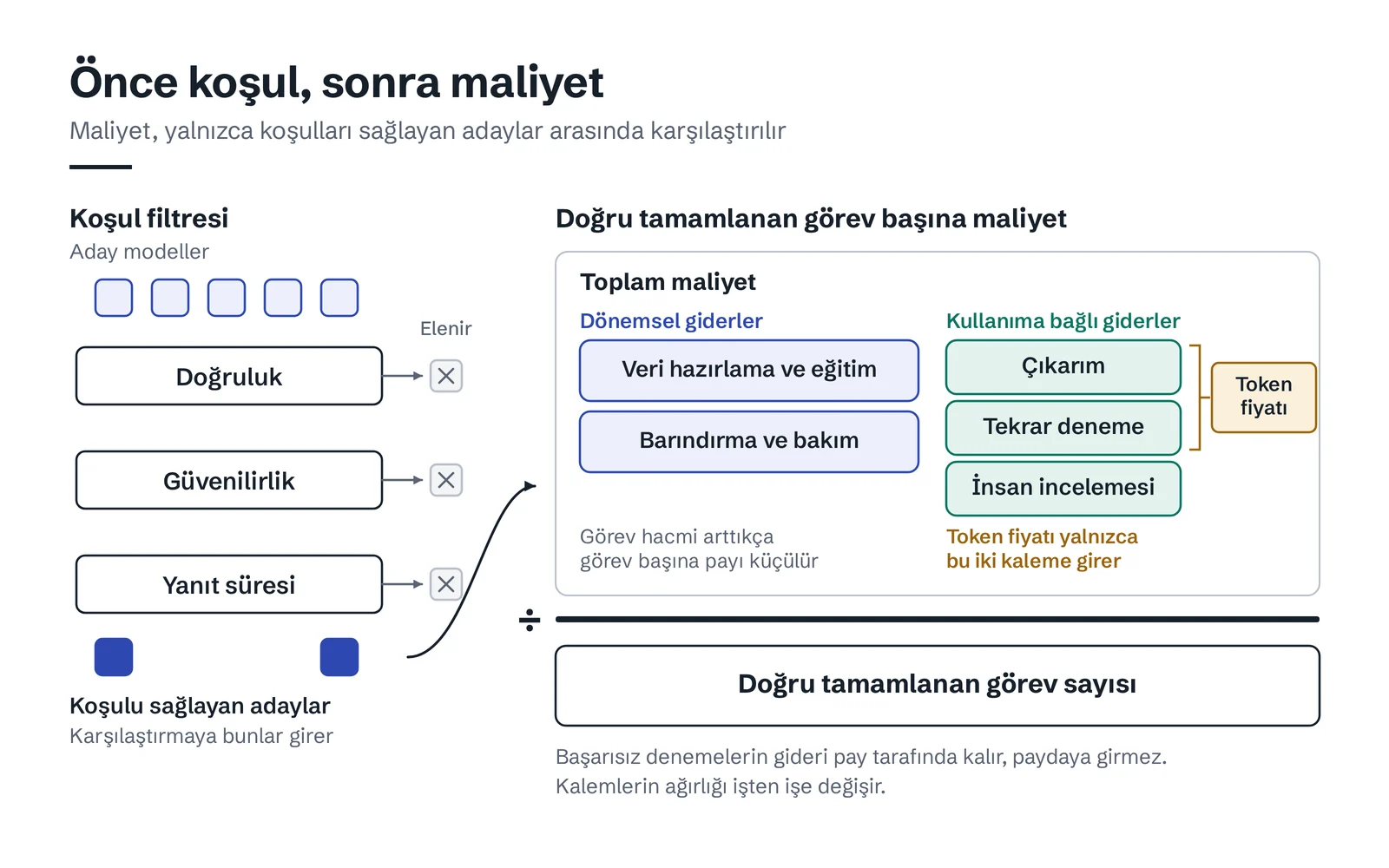
When making a decision, we first define the task and the errors that cannot be tolerated. Next, we eliminate the options that do not meet the required accuracy, reliability and response time. We compare costs only among the models that satisfy these conditions. In physical systems, we do not consider relaxing safety requirements for the sake of lower cost to be an option.
Fine-tuning is not economical in every case either. Data preparation and training have an upfront cost, while hosting and maintenance expenses continue throughout use. If a task is repeated often enough, the investment in specialization can pay off. If volume is low, the work changes frequently or data preparation is expensive, a strong general-purpose model may remain more economical. Our auto damage work explains why we keep task adaptation among the options. For a different job, the choice has to be re-evaluated.
When calculating cost in Physical AI, the completed physical task must also be the basis. How many times the robot attempts a grasp, how long it waits and how often an operator intervenes are all reflected in operating costs. Reducing a model's inference cost while lengthening the production cycle can result in a system that is more expensive overall.
Understanding the image, producing the motion
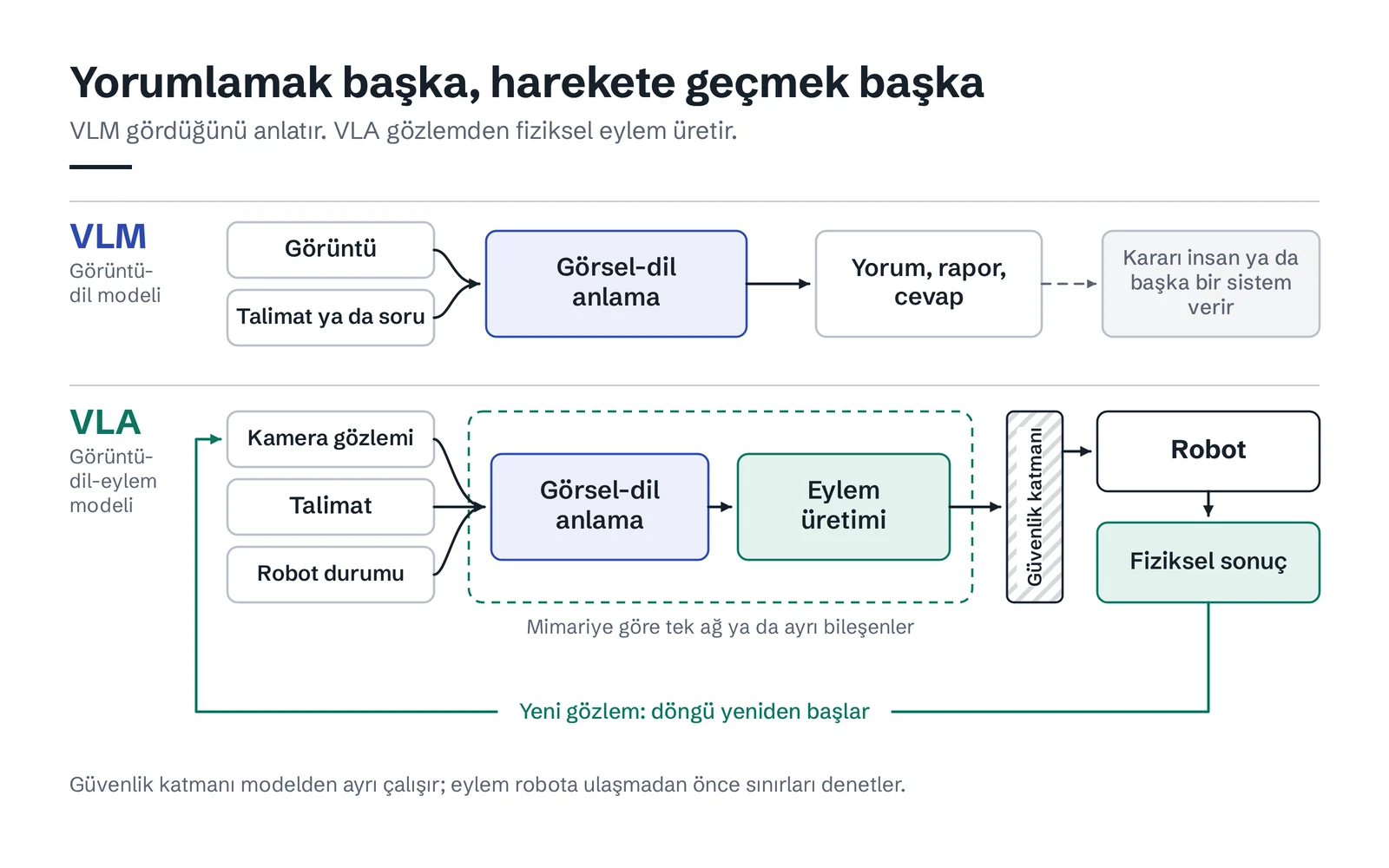
Vision-language models, or VLMs, make sense of what is in an image by relating it to language. Vision-language-action models, or VLAs, connect visual and linguistic information to a robot's actions. Between recognizing a part and grasping it with the right force lies a control process that must be continuously updated throughout the motion. In our Physical AI work, we evaluate a model's capabilities together with the hardware and control processes.
External research is also looking for answers to different engineering questions. In OpenVLA's Franka experiments, reaching full fine-tuning performance with LoRA while updating only 1.4% of the parameters is notable in terms of the training resources needed for adaptation. This finding matters for assessing the cost of giving a model task-specific capabilities. How many resources inference requires, however, needs to be measured separately.
Hugging Face's SmolVLA work highlights another approach: the next action is computed while the robot is still completing the current one. To reduce waiting time, the timing of computation is addressed alongside model size. This example shows that when evaluating a Physical AI architecture, we need to look at model selection and how computation is organized together. Using a smaller model is not, on its own, enough to get a fast robot.
The field changes the evaluation
Figure's account of its work at the BMW plant shows how decisive hardware is in physical systems. Figure 02's task was to place sheet metal parts into a welding fixture. The company reported that more than 90,000 parts were loaded over more than 1,250 hours of operation. We find the fact that the same report named the forearm as the main hardware failure point just as important as the production numbers.
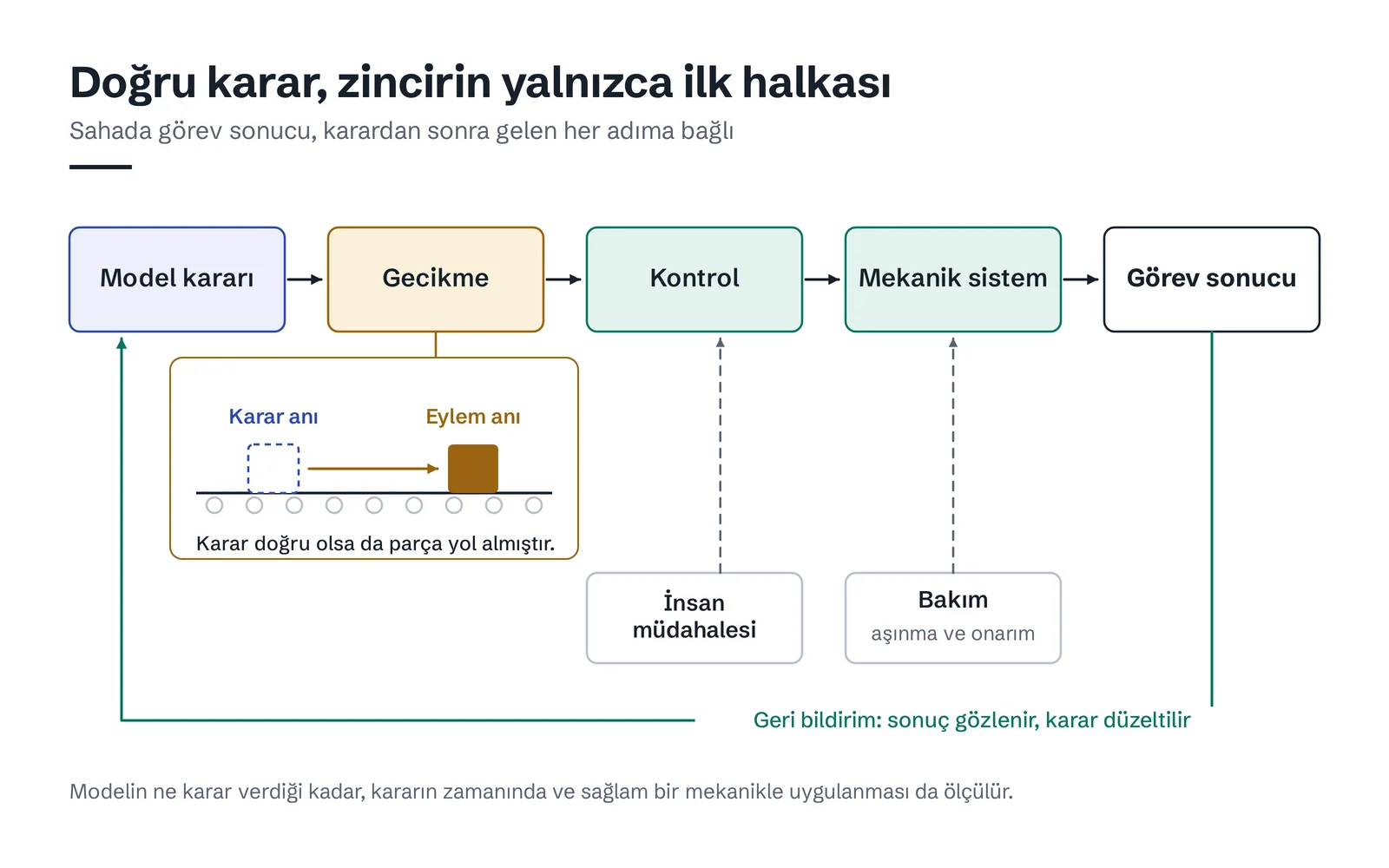
A model planning a task correctly does not solve the problem of mechanical durability. Maintenance needs and intervention time determine how usable the system is day to day. Safety cannot be left to the planning model either; it must be designed together with the control systems that directly drive the motion and the safety mechanisms in the hardware. That is why, in our Physical AI work, we evaluate model performance and system reliability separately.
One of the areas research still struggles with is making learned skills usable in changing environments. Can the robot carry on with the task when the object's position or the lighting changes? How does it behave when it meets an unexpected contact? These questions explain why data diversity is necessary. Making a result obtained on a single setup hold under different operating conditions requires additional work.
We expect more division of labor
In the coming period, we expect architectures that combine powerful planning models with specialized motion models running locally to become widespread. The model that interprets the environment and the model that responds quickly to real-time feedback do not have to be the same. Dividing the work can help allocate computing resources according to need and reduce dependence on network connectivity. This will also require setting up communication and error handling between the models correctly.
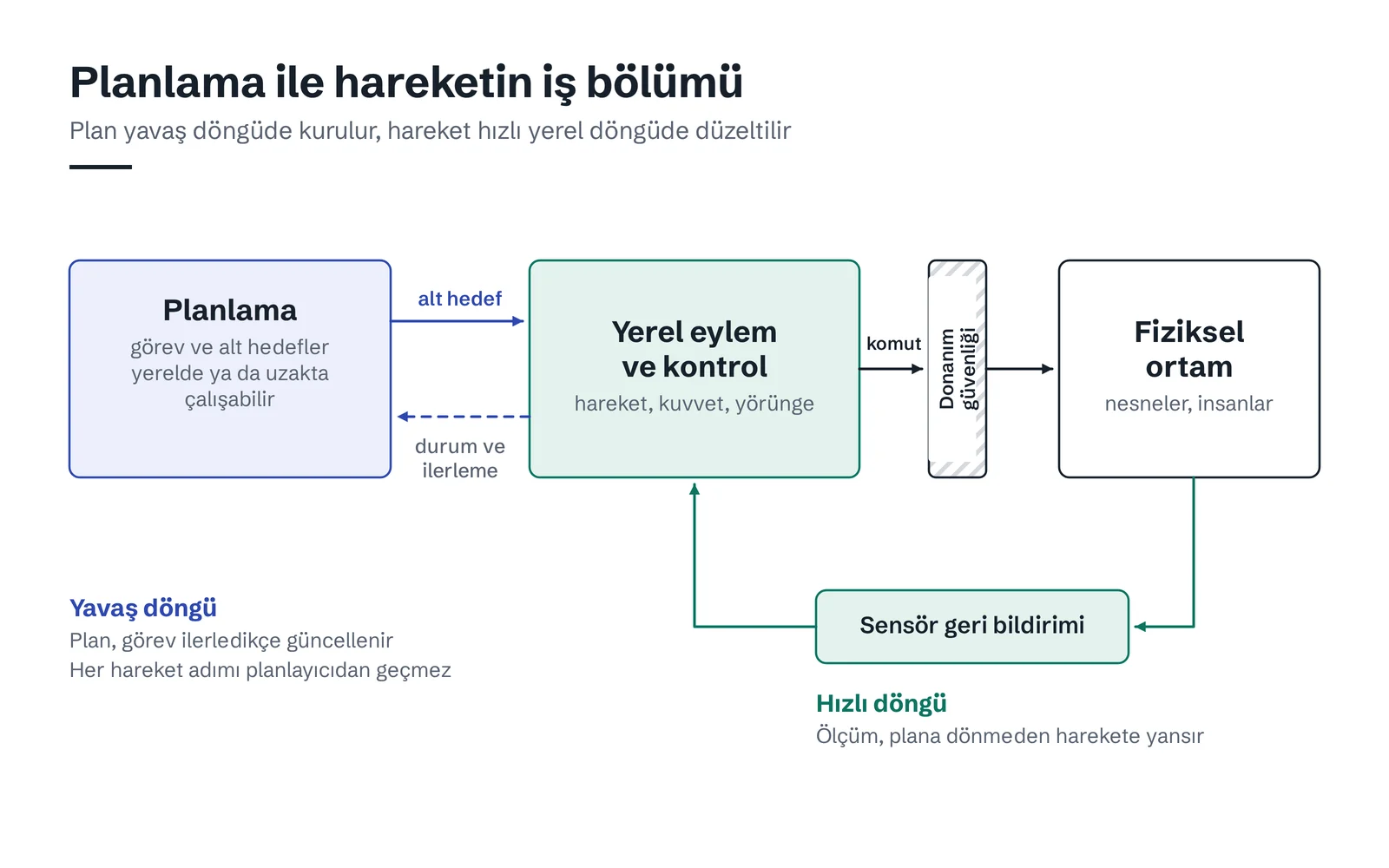
We also expect simulation to be used more in training. Trying out different conditions without putting real hardware at risk every time supports the learning process. Still, the effects of factors such as contact, wear and latency will need to be validated on real hardware. Diversifying training data and feeding field feedback into the learning process will be decisive for skills to carry over to new environments.
At Cerebrum Tech, we are continuing our Physical AI research with these questions in mind. We are evaluating the specialization opportunities we saw in our auto damage work while taking into account the different constraints of physical tasks. We are trying to understand not only the model's capabilities but also how it will fit with hardware and operating conditions. We want to shape our technical choices by weighing total cost together with the accuracy and safety requirements the task demands.
Sources
- OpenVLA — research site and fine-tuning experiments
- Hugging Face — SmolVLA: Efficient Vision-Language-Action Model
- Figure — F.02 Contributed to the Production of 30,000 Cars at BMW
- Google DeepMind — Gemini Robotics 2
- Google DeepMind — Gemini Robotics On-Device 2 model card
- Nikhil Sawane — When Fine-Tuning Hurts (15 December 2025)
- Xavier O’Keefe — Fine Tuning SmolVLA for New Environments (21 January 2026)
- Ville Kuosmanen — Sharing GPUs in AI Robotics with CUDA Streams (13 October 2025)
- LG AI Research — RFM: Action-Oriented Intelligence for Physical AI (26 June 2026)
- Ahabb Sheraz — Anatomy of VLA: Inside SmolVLA (1 August 2026)
- Shivam Kumar Singh — Teaching an SO101 to sort blue candies (19 October 2026)